

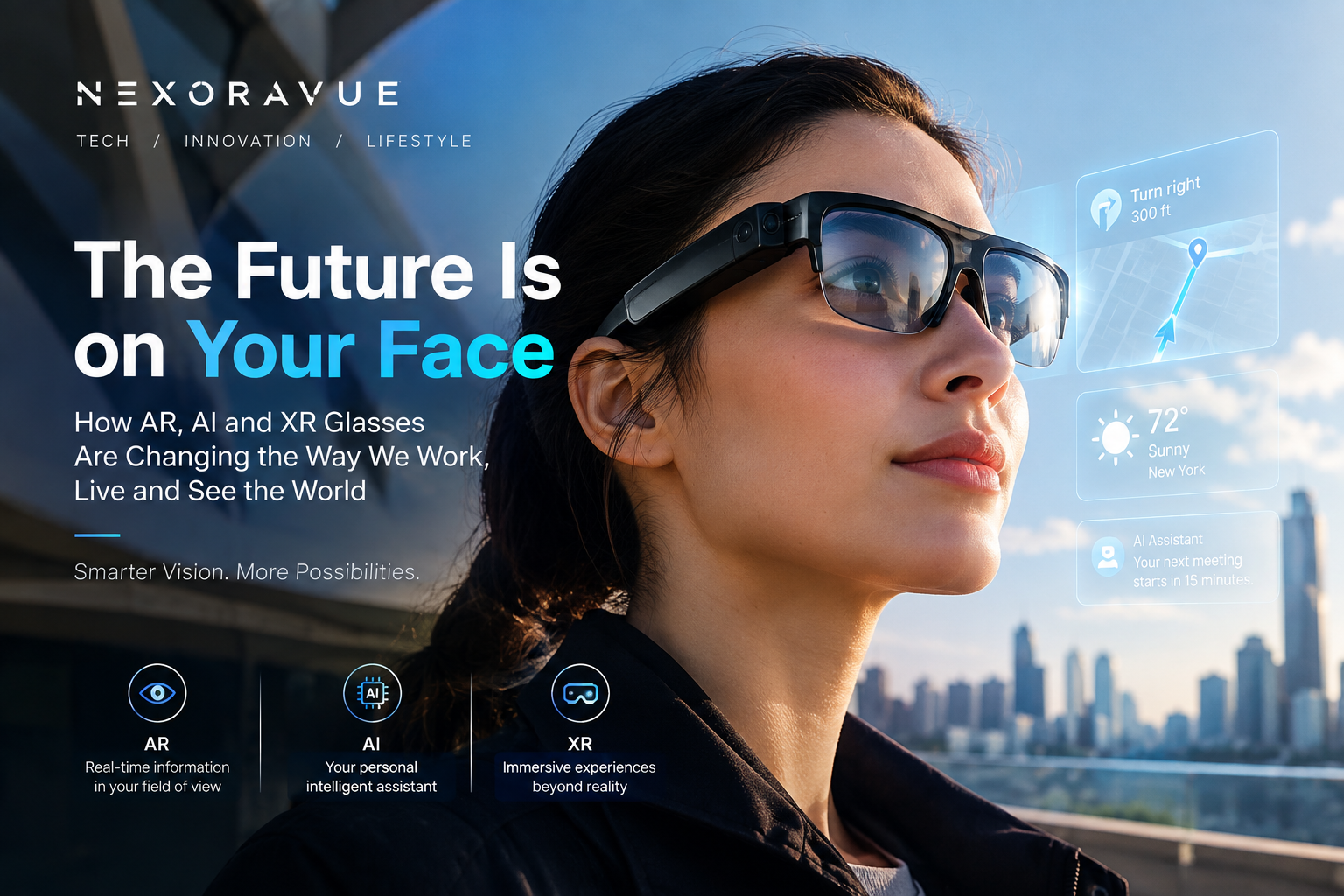
A New Era Beyond Smartphones
For more than a decade, smartphones have served as the center of our digital lives. We rely on them for communication, navigation, entertainment, work, and information. Yet despite their incredible capabilities, smartphones still require one fundamental action: taking them out of our pockets and looking down at a screen.
The next generation of computing is changing that.
AR, AI, and XR glasses are transforming how humans interact with digital information by bringing technology directly into our field of vision. Instead of forcing users to switch attention between the physical and digital worlds, smart glasses seamlessly merge the two.
Powered by advances in artificial intelligence, spatial computing, computer vision, and lightweight wearable hardware, smart glasses are quickly evolving from futuristic gadgets into practical everyday tools. Industry analysts increasingly view smart glasses as one of the fastest-growing segments within wearable technology and extended reality.
The future is no longer about carrying smarter devices. It's about wearing intelligence.
Understanding the Difference Between AR, AI, and XR Glasses
Although the terms are often used interchangeably, AR, AI, and XR glasses represent different layers of technological innovation.
AI Glasses
AI glasses focus on intelligent assistance through voice interaction, cameras, microphones, and cloud-based artificial intelligence.
These devices can:
-
Answer questions in real time
-
Translate conversations instantly
-
Identify objects and landmarks
-
Provide contextual information
-
Summarize meetings
-
Offer personalized recommendations
Modern AI glasses act as wearable digital assistants that understand both the user and the surrounding environment. Recent industry research describes this evolution as a shift toward "wearable intelligence" capable of delivering contextual assistance throughout daily life.
AR Glasses
Augmented Reality (AR) glasses add digital information directly onto the real world.
Instead of viewing content on a smartphone screen, users see:
-
Navigation directions
-
Notifications
-
Live translations
-
Interactive visual overlays
-
Digital workspaces
-
Educational content
AR creates a bridge between physical reality and digital information, allowing users to remain engaged with their surroundings while accessing powerful digital tools.
XR Glasses
XR, or Extended Reality, is an umbrella term that combines:
-
Augmented Reality (AR)
-
Virtual Reality (VR)
-
Mixed Reality (MR)
XR glasses represent the ultimate vision of spatial computing, where digital content becomes naturally integrated into the physical environment.
Future XR devices may allow users to:
-
Work with virtual monitors
-
Collaborate in 3D environments
-
Interact with digital objects anchored in real space
-
Experience immersive entertainment
-
Access AI-powered contextual information simultaneously
Many industry experts believe XR will eventually become a primary computing platform alongside smartphones and laptops.
Why Smart Glasses Are Gaining Momentum
The smart glasses industry has experienced a dramatic transformation over the past few years.
Several key factors are driving adoption:
Artificial Intelligence Breakthroughs
Large Language Models (LLMs) have dramatically improved the usefulness of wearable devices.
Instead of simple voice commands, modern AI systems can understand:
-
Context
-
Intent
-
Visual surroundings
-
User preferences
-
Real-world situations
This allows smart glasses to function as intelligent companions rather than passive accessories.
Improved Hardware Design
Earlier smart glasses often struggled with:
-
Bulky designs
-
Poor battery life
-
Limited functionality
Today's generation features:
-
Lightweight frames
-
Better cameras
-
Advanced microphones
-
Efficient processors
-
All-day wearability
Consumers are increasingly willing to adopt wearable technology when it looks and feels like traditional eyewear.
Maturing Display Technologies
Waveguide optics, micro-displays, and advanced projection systems are enabling smaller and more capable AR displays.
These innovations make it possible to present useful information directly within a user's field of view without obstructing natural vision.
Real-World Applications of AR, AI, and XR Glasses
The true value of smart glasses lies in their ability to enhance daily life.
1. Real-Time Translation
Language barriers can disappear almost instantly.
Imagine traveling abroad and seeing translated conversations, signs, menus, and directions without reaching for your phone.
For business professionals, international collaboration becomes more efficient and natural.
2. Intelligent Navigation
Traditional GPS requires users to repeatedly check a smartphone.
Smart glasses can project navigation guidance directly into the user's field of view, creating a safer and more intuitive experience while walking, cycling, or driving.
3. Enhanced Productivity
Professionals can benefit from:
-
Meeting reminders
-
Calendar notifications
-
AI-generated summaries
-
Voice note transcription
-
Hands-free communication
Instead of interrupting workflow, information becomes available exactly when needed.
4. Education and Learning
Students and lifelong learners can receive contextual information about:
-
Historical landmarks
-
Scientific concepts
-
Technical procedures
-
Language learning
Knowledge becomes instantly accessible in the environment where it is most relevant.
5. Content Creation
Creators can capture moments from a natural first-person perspective while keeping their hands free.
This opens new possibilities for:
-
Travel vlogging
-
Social media content
-
Live streaming
-
Professional documentation
6. Accessibility Support
One of the most impactful applications involves accessibility.
AI-powered smart glasses can help users by:
-
Reading text aloud
-
Describing surroundings
-
Recognizing objects
-
Providing navigation assistance
Wearable intelligence has the potential to significantly improve independence and quality of life.
The Rise of AI-Powered Wearable Intelligence
The most significant shift in smart glasses is not the hardware itself.
It's the emergence of wearable intelligence.
Traditional devices wait for user input.
Future AI glasses will proactively assist users by understanding:
-
Location
-
Activity
-
Context
-
Preferences
-
Daily habits
Imagine walking into a meeting and automatically receiving:
-
Participant information
-
Relevant documents
-
Previous discussion summaries
-
Suggested talking points
This transition from reactive technology to proactive assistance represents one of the most important developments in personal computing.
Challenges Facing the Industry
While the future looks promising, several challenges remain.
Battery Life
Consumers expect all-day performance from wearable devices.
Balancing power consumption with advanced AI functionality remains a key engineering challenge.
Privacy and Security
Because smart glasses often include cameras and microphones, privacy concerns continue to influence public adoption.
Manufacturers are increasingly focusing on:
-
Transparent recording indicators
-
User-controlled permissions
-
Local AI processing
-
Enhanced data protection
Trust will play a critical role in long-term adoption.
Display Limitations
For AR and XR glasses, achieving bright, high-resolution displays while maintaining lightweight designs remains a technical challenge.
Fortunately, rapid progress in optical technologies is helping overcome these limitations.
The Future of Smart Glasses
Industry forecasts suggest smart glasses are entering a period of accelerated growth.
Analysts report significant increases in global shipments, with AI-first glasses and display-enabled AR devices driving market expansion. Optical see-through AR glasses are expected to become one of the fastest-growing segments within the broader XR ecosystem.
Over the next decade, we can expect:
Smarter AI Assistants
AI will become more personalized, proactive, and context-aware.
Better AR Experiences
Visual overlays will become brighter, sharper, and more immersive.
Seamless Connectivity
Smart glasses will integrate effortlessly with smartphones, vehicles, smart homes, and workplace systems.
Spatial Computing Everywhere
Digital content will increasingly move from flat screens into three-dimensional environments.
Human-Centered Technology
Technology will become less visible while becoming more useful.
The ultimate goal is not to add more screens to our lives but to make information available naturally, when and where it matters most.
Why Nexoravue Believes in the Future of Smart Glasses
At Nexoravue, we believe the next generation of wearable technology should do more than connect people to information—it should enhance the way people experience the world.
The convergence of Artificial Intelligence, Augmented Reality, and Extended Reality is creating entirely new possibilities for communication, productivity, creativity, and exploration.
Smart glasses represent more than a new gadget category.
They represent a new relationship between humans and technology.
As AI becomes more intelligent and wearable hardware becomes more refined, AR, AI, and XR glasses will continue moving from innovation showcases to essential everyday companions.
The future of computing will not be held in our hands.
It will be worn before our eyes.
The evolution of smart glasses marks the beginning of a new digital era.
From AI-powered personal assistants and real-time translation to immersive AR experiences and future XR environments, these devices are reshaping how humans interact with information.
What once belonged to science fiction is rapidly becoming part of everyday reality.
And as the technology continues to advance, one thing is becoming increasingly clear:
The future is not on a screen.
The future is in your vision.